
 Tank Solutions – Fuel
Melbourne Markets
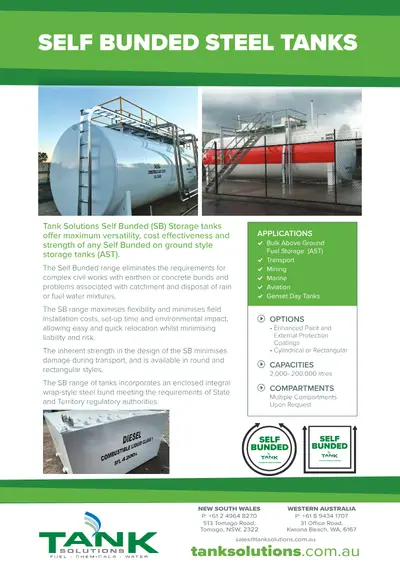
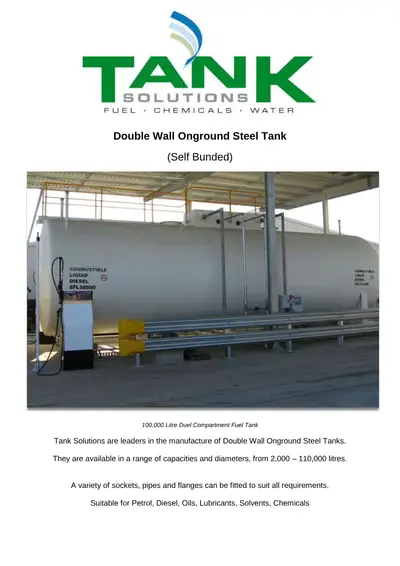
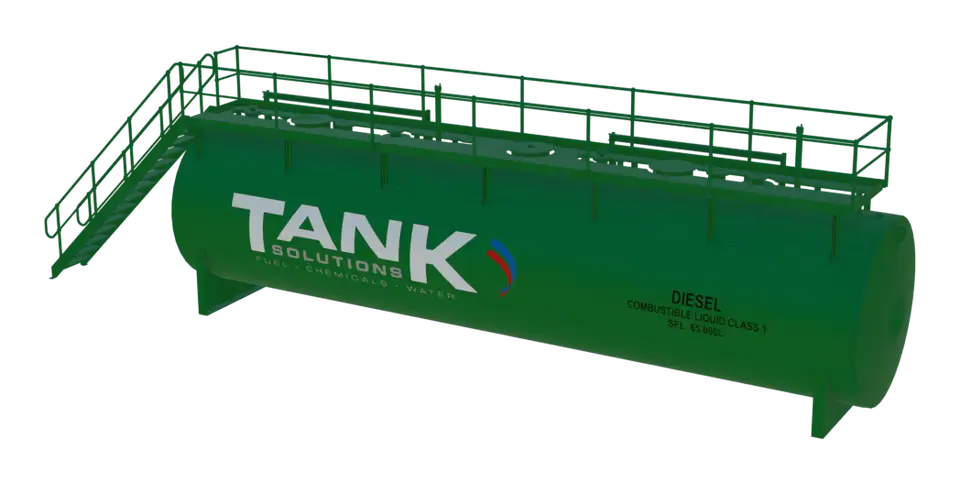
A 110,000L self-bunded, double-wall above-ground fuel tank, relocatable as the site changes.
Home / Products / Above-ground fuel / Self-bunded fuel tanks
Self-bunded tanks are double-wall steel bunded tanks with the bund built in, made to AS 1940 and AS 1692 at our ISO 9001 factories in Tomago NSW and Kwinana Beach WA. A self-bunded diesel tank needs no concrete bund, collects no rainwater to dispose of, and can be relocated as your site changes. Need a bigger or underground tank? Compare all our diesel fuel storage tanks.
Tell us roughly what you need. A sales engineer for your state replies within 2 business days.
Have drawings or a full spec? Use the detailed quote form, or call NSW +61 2 4964 8270 or WA +61 8 9434 1707.
The double wall is the bund. That minimises civil works on site, and because the tank is self-contained it can be moved as the site changes, which a fuel storage tank in a concrete bund can’t.
The integral wrap-style steel bund replaces earthen or concrete bunds.
Nothing collects in an open bund, so there’s no contaminated water to catch and treat.
Self-contained, so the tank can be moved to any practical location as the site changes.
The cylindrical shell with dished and flanged ends is designed for high pumping rates and resists transport damage.
Cut-off, anti-siphon valve and audible safe-fill alarm on every tank.
Manufactured to meet or exceed industry and statutory requirements.
A self-bunded tank is a tank inside a tank. The inner steel tank holds the fuel, and a second steel wall wrapped around it is the bund. If the inner tank leaks, the outer wall contains the fuel. Other bunded fuel tanks sit inside a concrete or earth bund built on site; because the containment is part of a self-bunded tank, you don’t build one around it.
| Feature | Self-bunded tank | Single-wall tank in a concrete bund |
|---|---|---|
| Civil works | No bund to build | Concrete bund built on site |
| Rainwater | No open bund, so nothing to collect | Rainwater collects in the bund and must be caught and disposed of |
| Relocation | Can be moved as the site changes | Fixed with the bund |
| Outlets | All openings above maximum liquid level (AS 1940 s5.9); no gravity feed | Bottom outlets for flooded suction and manifolded stock control |
| Capacity per tank | Up to 110,000L diesel or 55,000L petrol | Up to 150,000L, with tanks side by side in one bund |
| Best for | Depots, mines, data centres and sites that may change | Fuel farms and sites with an existing bund |
Single-wall details from our single-wall horizontal tank page.
The same double-wall tank stores diesel or petrol. What changes is how much one tank may hold, because AS 1940 treats flammable petrol more strictly than combustible diesel.
Diesel is a Class C1 combustible liquid under AS 1940. Approvals allow up to 110,000L of Class 3 PG III, C1 and C2 liquids in one self-bunded diesel storage tank.
Petrol (motor spirit) is a Class 3 PG II flammable liquid. Approvals allow up to 55,000L of it in one tank.
The tanks also store jet fuel, Avgas, kerosene, motor oil and many petrochemical and chemical liquids. Tell us what you’re storing and we’ll confirm the tank suits it. For corrosive chemicals such as acids, caustic soda and hypochlorite, see our FRP self-bunded chemical tanks.
Every tank is built to order at the capacity, shape and compartments your site needs. Tell us the volume and fuel, and we’ll send drawings with the dimensions and weight for your approval.
| Item | Self-bunded steel tank |
|---|---|
| Capacity | 2,000L to 200,000L |
| Diesel per tank | Up to 110,000L of Class 3 PG III, C1 and C2 liquids |
| Petrol per tank | Up to 55,000L of Class 3 PG II liquids |
| Shape | Cylindrical or rectangular |
| Compartments | Multiple compartments, configured to suit your site |
| Finish | Enhanced paint and external protective coatings available |
From the self-bunded steel tank data sheet (TD_TDS_024 Rev 0). Download the data sheet (PDF).
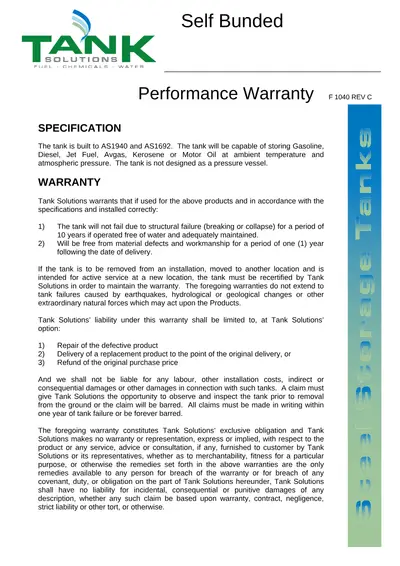
10 years on structural integrity when operated free of water and adequately maintained, and 1 year on materials and workmanship. Tanks are designed for ambient temperature and atmospheric pressure, not as pressure vessels. A relocated tank needs recertifying to keep the warranty.
Two Australian Standards decide whether an above-ground fuel storage tank passes. Our self-bunded tanks are manufactured to exceed AS 1692, in accordance with AS 1940.
AS 1940 is the standard for storing and handling flammable and combustible liquids, and it is what your site is usually assessed against.
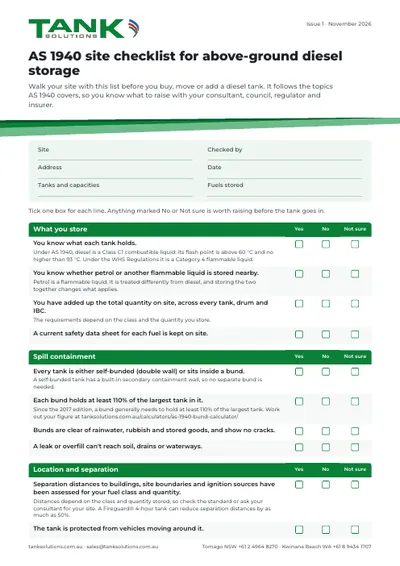
Read our plain-English AS 1940 guide, or download our AS 1940 site checklist (PDF) to walk your site with.
AS 1692 is the standard for steel tanks for flammable and combustible liquids. It covers design and construction, including tanks with built-in secondary containment.
| AS 1692 | Manufactured to exceed AS 1692; barrel wall thickness to Australian Standards. See what AS 1692 covers |
|---|---|
| AS 1940 | Storage and handling of flammable and combustible liquids; openings above maximum liquid level per Section 5.9 |
| Regulators | Integral wrap-style steel bund meets State and Territory regulatory requirements |
| ISO 9001 | Quality management certification at Tomago NSW and Kwinana Beach WA |
Local councils, state dangerous goods regulators and your insurer may have their own requirements. This section is general information, not compliance advice.
Our self-bunded fuel storage tanks are built to order at Tomago NSW and Kwinana Beach WA and delivered Australia-wide, with every quote priced with freight to your site.
We don’t hold stock. Each tank is built to your capacity, compartments and fittings, so ask for the current lead time when you request a quote.
Built at our ISO 9001 certified factories in Tomago NSW and Kwinana Beach WA.
We deliver anywhere in Australia, and your quote includes freight to site so the delivered cost is clear before you order.
We can coordinate all the freight requirements to get the tank to your site. Tanks sit on 150 mm cradles with lifting lugs.
The tank arrives with its containment, so there’s no concrete bund to pour and cure before it goes into service.
Fuel, volume, compartments and site. A sales engineer covering your state replies within 2 business days.
We confirm size, fittings and options, and send drawings for your approval.
Built at Tomago NSW or Kwinana Beach WA, both ISO 9001 certified.
Delivered to site, with no bund to build.
A 110,000L self-bunded, double-wall above-ground fuel tank, relocatable as the site changes.
Above-ground steel tanks to AS 1940 for standby generator fuel, including genset day tanks.
Where separation distances are tight, the 4-hour Fireguard® version can cut them by as much as 50%.
Can’t see yours? Call NSW +61 2 4964 8270 or WA +61 8 9434 1707.
A few details up front means your quote comes back faster, from the right engineer for your state. We price each tank to your spec, with no obligation, and reply within 2 business days.
Your enquiry has gone to our sales team. A sales engineer will be in touch within 2 business days.
Need it sooner? Call NSW +61 2 4964 8270 or WA +61 8 9434 1707.
Please email your drawings and documents to sales@tanksolutions.com.au with your name in the subject line, so we can add them to this enquiry.
Compare every option in above-ground fuel storage tanks.
Insulated double-wall steel tank rated to the SwRI 4-hour fire test.
Double-wall steel tank with interstitial monitoring, 2-hour fire rated.
Cylindrical steel tank on welded cradles, for use in a concrete bund.