
Home / Tank materials / Glasteel® II
 Tank Solutions – Fuel
Glasteel® II tanks
Glasteel® II puts a welded steel tank inside a fibreglass (FRP) outer wall. This guide explains how it is built, why you would choose it for underground fuel, and when an all-fibreglass tank suits better.
Get a price
Tell us roughly what you need. A sales engineer for your state replies within 2 business days.
Have drawings or a full spec? Use the detailed quote form, or call NSW +61 2 4964 8270 or WA +61 8 9434 1707.
What Glasteel® II is
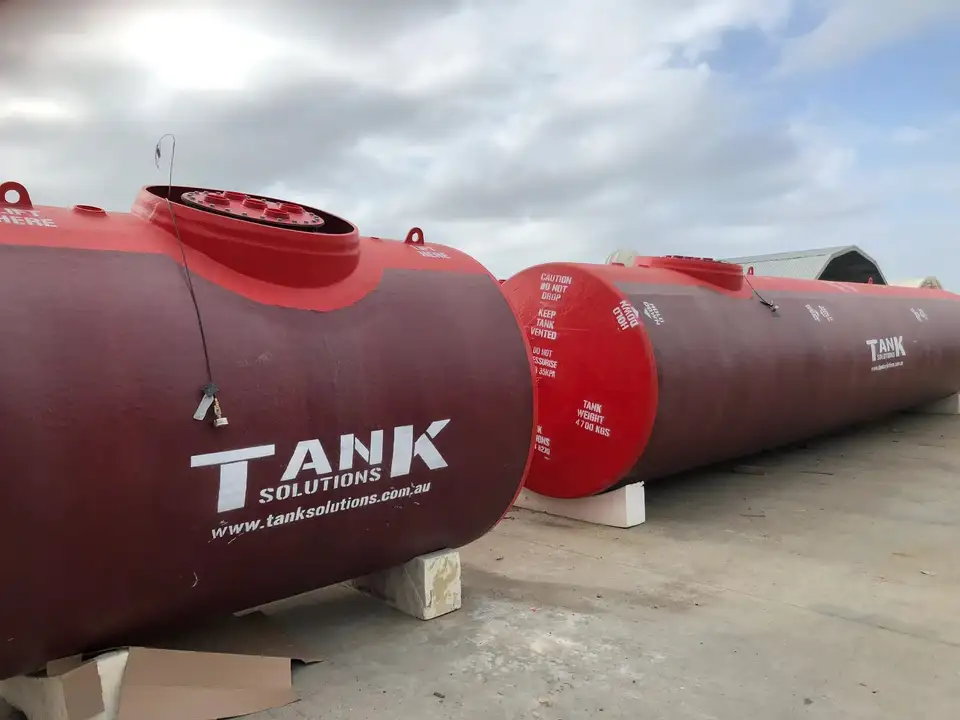
Glasteel® II is an FRP-clad steel tank, made under licence from the Steel Tank Institute (STI). The steel inner wall carries the structural load. The FRP outer wall forms the secondary containment.
We are a Steel Tank Institute member and licensee for Glasteel® II underground tanks. We make them at our Tomago NSW and Kwinana Beach WA sites, both certified to ISO 9001.
Where Glasteel® II is used
- Service station forecourts
- Fleet and transport depots
- Defence and government fuel installations
- Industrial sites storing fuels or chemicals underground
How it is built
The steel tank and the FRP outer wall each do a different job.
The steel inner tank
- Welded mild steel, which carries the structural load
- Single or multiple compartments
- Internal liners can be specified for other applications
- Manufactured to UL 58 and AS 1692
The FRP outer wall
- Fully encloses the steel tank, including its fittings
- Forms the secondary containment if the inner wall ever leaks
- Isolates the steel from soil, groundwater and acid or alkaline ground conditions
- The space between the walls is put under vacuum at the factory and fitted with a vacuum gauge
Forecourt fit-outs use 1,200 mm risers with 600NB manways and 5 × 100NB sockets for retail pressure systems, or 1,500 mm risers for large submersible turbines.
Why choose Glasteel® II
Glasteel® II suits sites that want a steel structural tank underground, without managing corrosion on the steel.
The strength of steel
The welded steel inner tank carries the load. It suits high-head filling where deep burial is required, and pumping in and out of the tank in generator applications.
Steel kept out of the ground
The FRP outer wall fully encloses the steel, so it never touches soil or groundwater.
No cathodic protection
The FRP outer wall resists corrosion, so the tank needs no cathodic protection.
Secondary containment
The steel tank sits completely inside the FRP outer wall, which contains a leak from the inner wall. See double-wall tanks.
Vacuum leak monitoring
A break in the inner or outer wall causes a loss of vacuum, so a regular check of the gauge confirms the tank’s integrity.
30-year warranty
30 years against corrosion and structural failure, and 1 year on materials and workmanship. See the Glasteel® II warranty.
When another tank suits better
Glasteel® II and double-wall fibreglass both give double-wall containment for underground fuel, with the space between the walls monitored. Above ground, our fuel tanks are steel.
| If you need | Consider | Why |
|---|---|---|
| Fibreglass inside and out, with continuous hydrostatic leak monitoring | Double-wall FRP | Rust-proof with no corrosion inside or out, Truchek® hydrostatic monitoring and up to 4 compartments, from 2,000L to 150,000L. |
| A light underground tank where containment isn’t required | FRP single-wall | Lighter, delivered complete and quick to install. Holds fuels, AdBlue or water, depending on the application. |
| An above-ground fuel tank | Steel | Single-wall or double-wall self-bunded steel tanks to AS 1692 and AS 1940, with fire-rated Fireguard® 4-hour options. |
How the two leak monitoring systems work: Truchek® hydrostatic monitoring on double-wall FRP, and the factory-fitted vacuum gauge on Glasteel® II.
Standards
| STI Glasteel® II | Manufactured under licence from the Steel Tank Institute. See accreditation. |
|---|---|
| UL 58 | Steel underground tanks for flammable and combustible liquids. |
| AS 1692 | Steel tanks for flammable and combustible liquids, above and below ground. See what AS 1692 covers. |
| AS 4897 | The design, installation and operation of underground petroleum storage systems. It calls for non-corroding tanks and pipework, secondary containment and overfill protection. |
| Installation | By an accredited Glasteel® installer. See the installer directory. |
General information only, not compliance advice. Your state regulator and site engineer set what applies to your site.
Glasteel® II and other underground tanks
Glasteel® II underground fuel tanks
A welded mild steel tank with an FRP outer layer that provides secondary containment, leak protection and corrosion resistance.
Double-wall fibreglass fuel tanks
Double-wall FRP tank with 360-degree secondary containment.
Service station fuel tanks
Double-wall FRP underground fuel tanks for new service stations, upgrades and replacements, with full 360-degree secondary containment.
Calculators and quizzes for underground tanks
Free to use, with a PDF report and a quote request filled in from your answers. All calculators and quizzes
Is your old single-wall tank a risk?
Which of the published reasons for replacing an underground fuel tank apply to yours.
Check your tankForecourt tank sizing
Tank and compartment sizes for each fuel grade from what you sell or use a week.
Size the tanksFuel leak cost
What one leak from a single-wall tank would cost your site, beside the price of a double-wall replacement.
Cost a leakCommon questions
Can’t see yours? Call NSW +61 2 4964 8270 or WA +61 8 9434 1707.