
Home / Tank materials / Steel tanks
 Tank Solutions – Fuel
Steel fuel storage tanks
Our above-ground fuel tanks are steel, single-wall or double-wall. This guide explains how they are built, why you would choose steel, and when fibreglass or Glasteel® II suits your site better.
Get a price
Tell us roughly what you need. A sales engineer for your state replies within 2 business days.
Have drawings or a full spec? Use the detailed quote form, or call NSW +61 2 4964 8270 or WA +61 8 9434 1707.
What a steel tank is
A steel fuel tank is built to AS 1692, the standard for steel tanks for flammable and combustible liquids. Ours store diesel, petrol, jet fuel, Avgas, kerosene, motor oil and many petrochemical and chemical liquids.
Every tank is built to order at our ISO 9001 factories in Tomago NSW and Kwinana Beach WA, and delivered Australia-wide. You tell us the fuel, volume and site. We send drawings for your approval before manufacture.
Where steel tanks are used
- Mine sites and remote camps
- Transport and fleet depots
- Standby generators and data centres
- Defence bases and fuel farms
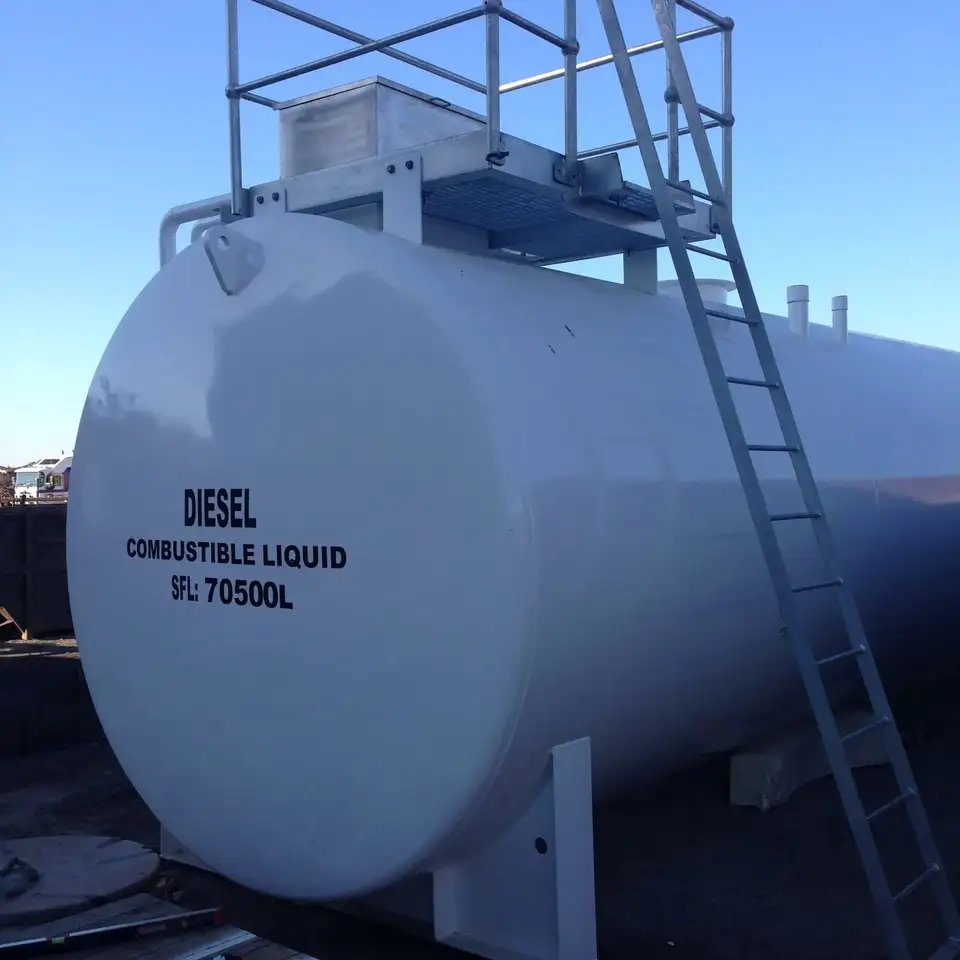
Single-wall and double-wall steel
The main choice with steel is whether the containment is a concrete bund on site or a second steel wall built into the tank.
Single-wall steel
- One steel shell that sits in a simple concrete bund
- Horizontal tanks from 2,000L to 150,000L, to AS 1692 Category 4, on fully welded steel cradles
- Bottom outlets and fill lines give a flooded-suction, manifolded system for easy stock control
- Several tanks can sit side by side in one bund and be manifolded to cut pipework
- Vertical tanks and silos hold more on less ground, with an optional shop-built integral bund to AS 1940
Double-wall steel
- A tank inside a tank. The inner steel tank holds the fuel and the outer steel wall is the bund
- Self-bunded tanks from 2,000L to 200,000L, up to 110,000L of diesel or 55,000L of petrol per tank
- No concrete bund to build and no rainwater to dispose of
- Self-contained, so the tank can be moved as the site changes
- Fire-rated versions: Fireguard® (4-hour fire test) and Flameshield® (2-hour fire test, with interstitial monitoring)
More on how a second wall contains a leak in our guide to double-wall tanks.
Why choose steel
Steel is our material for above-ground fuel storage. It suits sites that want the bund built in, a fire rating, or large volumes in an existing bund.
Made for above-ground fuel
AS 1692 is written for steel tanks for flammable and combustible liquids, above and below ground. Our above-ground tanks are built to AS 1692 and AS 1940.
The bund built in
On a double-wall tank the outer steel wall is the containment, so there are no earthen or concrete bunds to build and nothing collects in an open bund.
Moves with your site
A self-bunded tank can be moved to any practical location. If it is relocated, it needs recertifying to keep the warranty.
A fire rating when space is tight
Fireguard® tanks are rated to the SwRI 4-hour fire test and can reduce separation distances by as much as 50%. Flameshield® tanks are accredited to a 2-hour fire test. See Fireguard® 4-hour.
Shapes to suit the footprint
Horizontal or vertical, cylindrical or rectangular, depending on the tank. Vertical tanks and silos hold more on less ground.
Several grades in one tank
Self-bunded and Flameshield® 2-hour tanks can be built with separate compartments, so one tank can hold diesel and petrol.
When fibreglass or Glasteel® II suits better
Steel is not the answer for every tank. Underground fuel, corrosive chemicals and water storage usually call for fibreglass, or a steel tank wrapped in fibreglass.
| If you need | Consider | Why |
|---|---|---|
| An underground fuel tank with no corrosion to manage | Fibreglass (FRP) | Fibreglass doesn’t rust, inside or out. Double-wall FRP tanks run from 2,000L to 150,000L with Truchek® leak monitoring. |
| A steel structural tank underground | Glasteel® II | A welded steel tank fully enclosed in an FRP outer wall, so the steel never touches soil or groundwater and needs no cathodic protection. |
| Storage for acids, caustic soda or hypochlorite | FRP chemical tanks | FRP resists acids, caustic and process reagents without the coating maintenance a steel tank in the same duty would need. |
| Drinking water, stormwater or wastewater | FRP water tanks | The FRP laminate is rust and corrosion proof, with no lining or coating, and the tanks go in below the water table. |
Standards
The standards our steel tanks are built to, and the one your site is usually assessed against.
| AS 1692 | Steel tanks for flammable and combustible liquids. It covers design and construction, including tanks with built-in secondary containment. See what AS 1692 covers. |
|---|---|
| AS 1940 | The storage and handling of flammable and combustible liquids. It sets spill containment, overfill protection, venting and separation distances. See our AS 1940 guide. |
| UL 142 | Steel above-ground tanks for flammable and combustible liquids. Flameshield® 2-hour tanks are built to it. |
| STI Fireguard® | Fireguard® 4-hour tanks are made under licence from the Steel Tank Institute. |
| ISO 9001 | Quality management certification at our Tomago NSW and Kwinana Beach WA factories. See accreditation. |
General information only, not compliance advice. Your state regulator and site engineer set what applies to your site.
Our steel tanks
Self-bunded diesel & fuel tanks
Relocatable double-wall steel tank that needs no on-site bund.
Fireguard® 4-hour fire-rated tanks
Insulated double-wall steel tank rated to the SwRI 4-hour fire test.
Single-wall horizontal above-ground tanks
Cylindrical steel tank on welded cradles, for use in a concrete bund.
Single-wall vertical above-ground tanks
Vertical steel tanks and silos where footprint matters.
Flameshield® 2-hour fire-rated tanks
Double-wall steel tank with interstitial monitoring, 2-hour fire rated.
Calculators and quizzes for steel tanks
Free to use, with a PDF report and a quote request filled in from your answers. All calculators and quizzes
Which fuel tank fits your site?
Eight quick questions. You get the tank that fits and up to two alternatives, with the reason for each.
Find your tankAS 1940 bund capacity
How much a bund needs to hold for your tanks, and whether a proposed bund holds enough.
Check the bundFireguard® site area
The ground a Fireguard® 4-hour tank frees up by cutting separation distances, and what it is worth.
Work out the ground freedCommon questions
Can’t see yours? Call NSW +61 2 4964 8270 or WA +61 8 9434 1707.