
Home / Tank materials / Fibreglass (FRP) tanks
 Tank Solutions group
Fibreglass (FRP) tanks
Fibreglass reinforced plastic is our material for underground fuel, chemical storage and water. This guide explains how FRP tanks are built, why you would choose fibreglass, and when steel or Glasteel® II suits better.
Get a price
Tell us roughly what you need. A sales engineer for your state replies within 2 business days.
Have drawings or a full spec? Use the detailed quote form, or call NSW +61 2 4964 8270 or WA +61 8 9434 1707.
How an FRP tank is built
An FRP tank is a laminate of glass and resin. The resin and the wall design change with what the tank holds.
- Fuel tanks use virgin resins and glass with no fillers, with ribs formed into the wall for strength
- Double-wall fuel tanks add Parabeam 3-dimensional fibreglass to both walls
- Chemical tanks use a resin system selected for the chemical and concentration stored, with a smooth glass-resin interior
- Water tanks use premium resin without fillers and integral high-profile fibreglass ribs
- Sewage pump stations are laminated in one piece from premium-grade vinyl ester resin and glass
Every tank is built to order at our ISO 9001 factories in Tomago NSW and Kwinana Beach WA.
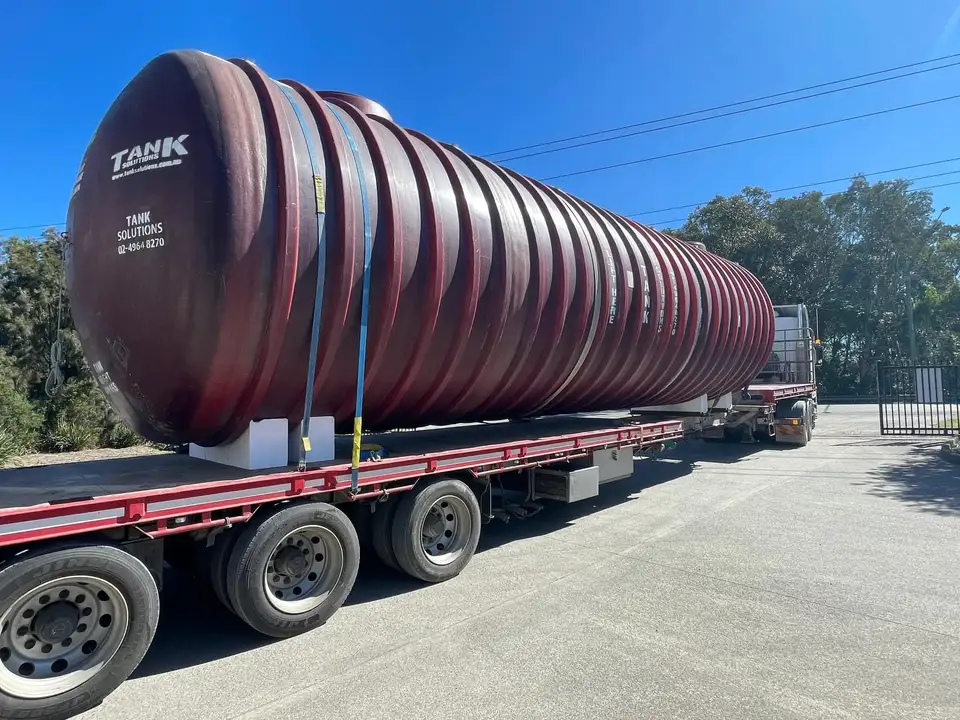
Why choose fibreglass
FRP suits tanks that sit in the ground, hold something corrosive, or have to reach a remote site.
No rust or corrosion
Fibreglass doesn’t rust, inside or out. Underground there is no cathodic protection to maintain, and water tanks need no lining or coating.
Resists chemical attack
With the resin matched to the chemical, FRP resists acids, caustic and process reagents without the coating maintenance a steel tank would need.
Light to ship and place
FRP tanks are light to ship, and a large-capacity water tank fits on one truck bed. Single-wall tanks are easier to lift and quicker to install.
Goes in below the water table
Integral high-profile ribs mean our FRP water tanks are not limited by the water table.
Watertight
Chemical and water tanks are designed to be 100% watertight. Chemical tanks have no on-site sealed joints, and pump stations are one piece.
Little upkeep
FRP water and wastewater tanks need no ongoing maintenance or inspections.
FRP for fuel, chemicals and water
We sell FRP tanks under three brands, one for each application.
Underground fuel
Single-wall and double-wall FRP underground tanks for service stations, depots and AdBlue. Double-wall tanks are built to UL 1316.
View underground tanksChemical storage
FRP tanks for acids, caustic soda, sodium hypochlorite and water treatment chemicals, single-wall or self-bunded, plus scrubbers and stacks.
View chemical tanksWater & wastewater
FRP potable water, stormwater and wastewater tanks up to 150,000L for some applications, and one-piece FRP sewage pump stations.
View water tanksFibreglass for underground fuel
Our underground fuel tanks are fibreglass, or Glasteel® II steel with an FRP outer wall. Within fibreglass, the choice is single-wall or double-wall.
Double-wall FRP
- An outer FRP wall surrounds the primary wall completely, for 360° secondary containment
- Truchek® hydrostatic monitoring of the space between the walls, which meets EPA requirements
- 2,000L to 150,000L, with 1 to 4 separate compartments
- 30 years against failure from internal corrosion, and 30 years against structural failure when a qualified contractor performs and validates the installation
- See double-wall fibreglass fuel tanks and double-wall tanks
Single-wall FRP
- One FRP wall, light and delivered complete, ready to install
- Suits water, AdBlue and sites where a quick install matters
- Where full secondary containment is needed, choose double-wall
- See FRP single-wall underground tanks
Underground FRP tanks are installed by an accredited installer. A non-accredited installation voids the warranty.
When steel or Glasteel® II suits better
Fibreglass is not the right material for every tank. These are the cases where we would point you to steel.
| If you need | Consider | Why |
|---|---|---|
| An above-ground fuel tank | Steel | Our above-ground fuel tanks are steel, built to AS 1692 and AS 1940. Self-bunded tanks need no concrete bund and can be moved later. |
| A fire rating to cut separation distances | Fireguard® 4-hour | An insulated double-wall steel tank that is rated to the SwRI 4-hour fire test and can reduce separation distances by as much as 50%. |
| A steel structural tank underground | Glasteel® II | A welded steel tank inside an FRP outer wall. It suits high-head filling where deep burial is required, and pumping in and out in generator applications. |
Standards
The standards our FRP tanks are built and tested to, by application. AS 1692 is written for steel tanks, so fibreglass fuel tanks are built to UL 1316 instead.
| UL 1316 | Glass-fibre-reinforced plastic underground storage tanks for petroleum products. Our double-wall FRP fuel tanks are manufactured to meet or exceed it. |
|---|---|
| AS 4897 | The design, installation and operation of underground petroleum storage systems. Double-wall FRP tanks get a third-party tank test after installation, using USEPA methods. |
| AS 1940 | Underground fuel tank venting must comply with Section 5.4. See our AS 1940 guide. |
| AS 2634 | Chemical plant equipment made from glass-fibre reinforced plastics. Applies to our chemical tanks. |
| BS 4994 | Design and construction of vessels and tanks in reinforced plastics. Applies to our chemical tanks. |
| ASME RTP-1 | Reinforced thermoset plastic corrosion-resistant equipment. Applies to our chemical tanks. |
| WSA 04 | Mullaly pump stations have been evaluated through WSAA’s national product appraisal scheme, to the WSA 04 Sewage Pumping Station Code. |
| ISO 9001 | Quality management certification at our Tomago NSW and Kwinana Beach WA factories. See accreditation. |
General information only, not compliance advice. Your state regulator and site engineer set what applies to your site.
Our FRP tanks
Double-wall fibreglass fuel tanks
Double-wall FRP tank with 360-degree secondary containment.
FRP single-wall underground tanks
Lightweight FRP tank, delivered complete and ready to install.
Service station fuel tanks
Double-wall FRP underground fuel tanks for new service stations, upgrades and replacements, with full 360-degree secondary containment.
AdBlue storage tanks
Underground FRP tanks for AdBlue (diesel exhaust fluid), in single or double-wall, as a stand-alone tank or a compartment alongside other fuels.
FRP chemical storage tanks
Custom-made FRP tanks for acids, caustic soda, sodium hypochlorite, dosing systems and water treatment chemicals, single-wall or bunded.
FRP scrubber & stack
FRP chemical fume scrubbers, exhaust and vent stacks, ducting and bio-filters, custom-engineered with the designer or asset owner for odour control and containment.
Potable water tanks
FRP water storage tanks for drinking water, built with integral fibreglass ribs, premium resin without fillers and a design that is 100% watertight.
Wastewater & effluent tanks
Underground FRP tanks for wastewater and effluent, corrosion resistant to the stored liquid and the surrounding soil, and designed to be 100% watertight.
Stormwater tanks
Underground FRP tanks for stormwater storage, lightweight to ship and easy to install in remote locations and tight footprints.
Fibreglass pump stations
One-piece FRP pump stations built to each project's specification, WSAA appraised and quick to install on site.
Calculators and quizzes for fibreglass fuel tanks
Free to use, with a PDF report and a quote request filled in from your answers. All calculators and quizzes
Is your old single-wall tank a risk?
Which of the published reasons for replacing an underground fuel tank apply to yours.
Check your tankForecourt tank sizing
Tank and compartment sizes for each fuel grade from what you sell or use a week.
Size the tanksFuel leak cost
What one leak from a single-wall tank would cost your site, beside the price of a double-wall replacement.
Cost a leakCommon questions
Can’t see yours? Call NSW +61 2 4964 8270 or WA +61 8 9434 1707.